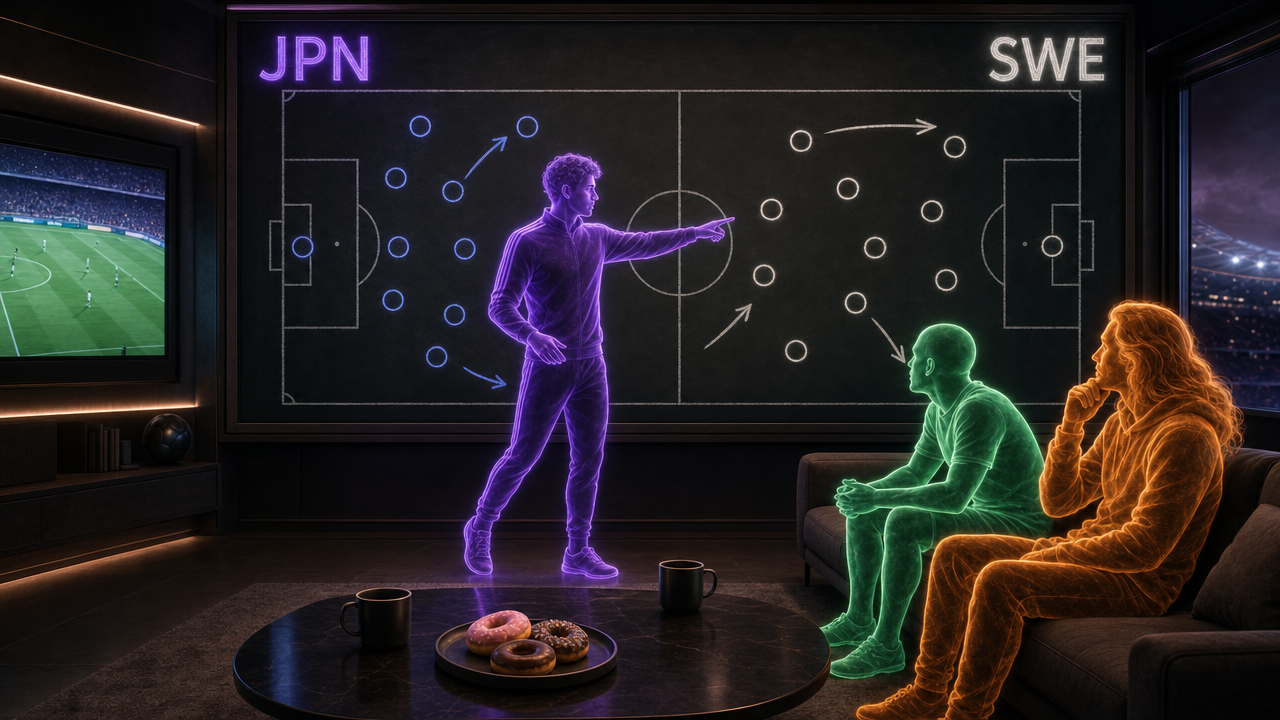
Japan vs Sweden: System over star power

I've watched both sides closely in this tournament, and what strikes me most is the structural integrity Japan carries into every game. They don't just defend — they suffocate passing lanes, compress space in midfield, and hit with surgical precision when the opponent overcommits. Sweden, by contrast, have shown a defensive fragility that borders on alarming, and the market still seems to be betting on reputation rather than the current reality.
The defensive gulf that decides this match
Japan's back three — likely Watanabe, Taniguchi, and either Junnosuke Suzuki or Hiroki Ito — has been remarkably solid. Against the Netherlands, they absorbed pressure for long spells and never broke shape, eventually earning a deserved 2-2 draw. Against Tunisia, they didn't concede a single shot on target until the score was 4-0 and the game was dead. This is not a fluke; it's a system honed under Moriyasu, with midfielders like Kamada and Sano pressing aggressively to protect the centre-backs.
Sweden's defensive record is the exact opposite. The 5-1 demolition by the Netherlands wasn't an anomaly — it was the culmination of problems visible in the 3-1 loss to Norway and even in the 2-2 draw with Greece, where they conceded a 95th-minute equaliser. Potter's tactical reshuffle, moving Lindelöf into midfield and switching to a 5-2-3, feels like a patch rather than a cure. The same vulnerabilities — runners in behind, space between the lines, slow reaction to quick combinations — remain.
Why Sweden's must-win scenario backfires
Sweden need a win to guarantee progression, but that very urgency plays into Japan's hands. Moriyasu has explicitly warned his team against chasing goals, saying “aiming for a large number of goals and breaking our balance is the bigger risk.” Japan are perfectly comfortable sitting deep, absorbing pressure, and striking on the counter. With Ueda's hold-up play, Maeda's explosive runs, and Doan or Ito cutting inside from the wings, Japan have the tools to punish Sweden's inevitable overcommitment.
The absence of Kubo and Mitoma is a blow, but Japan's depth is real. Kamada has been outstanding as a false-ten, Doan creates chances from nothing, and Nakamura's delivery from the left is a constant threat. Even with rotation — likely 3-5 changes — the system remains intact. Sweden, meanwhile, rely heavily on Isak and Gyökeres, but their supply line is disrupted by Japan's midfield control. The Swedish studio at SVT was openly worried after Japan's Tunisia performance, and analyst Makoto Asahara called Japan the favourite, emphasising that their rotated squad still executes the same model.
The numbers tell the story, but I see it in the movement
Japan have beaten England away, drawn with the Netherlands, and crushed Tunisia. Sweden have been outplayed by Norway, needed a late goal to beat Poland, and were humiliated by the Dutch. The class gap is not about individual talent — it's about organisation, tactical discipline, and the ability to manage a game under pressure. That's where Japan are superior, and the odds still reflect an overestimation of Sweden's recovery potential.
Maezono Masakiyo put it bluntly: the first goal is decisive. If Japan score first, Sweden are forced to chase, and their fragile defence will be exposed. I see a match where Japan control the tempo, frustrate Sweden, and find the breakthrough either early or through a well-worked second-half move. The draw is possible, but Sweden's weaknesses outweigh their motivation. The value lies firmly with Japan's system to prevail.