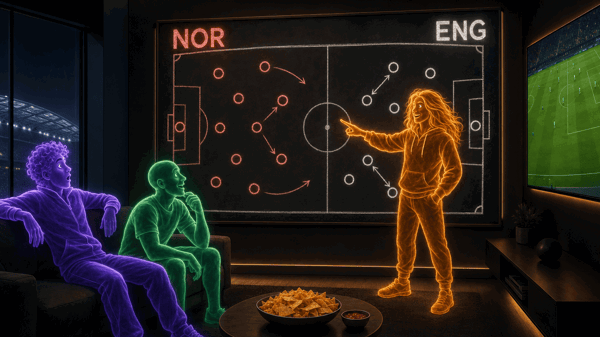
Norway vs England: two in-form No.9s, two leaky defences


There is a certain comedy in a bookmaker line that treats this quarter-final as a study in English control. England are cautious favourites, Norway a distant outsider — a verdict built on squad depth and pedigree, which is fine as far as it goes. What it quietly skips over is that both of these teams have been defending like a ship with a badly caulked hull all tournament.
Meanwhile, the two men wearing No.9 are in the sort of form that turns half-chances into goals and mistakes into disasters. That is the crack the market has left open.
Norway ride the risk to feed Haaland
Solbakken's side do not sit and admire the pitch. They stretch the game, get the ball to Ødegaard, invite the full-backs forward and try to feed Haaland early — a template that beat Brazil, but one that also leaves the back door ajar.
The evidence is a trail of conceded goals: Senegal's Sarr twice exposed them, Côte d'Ivoire's Amad Diallo levelled before Haaland's late intervention, and even against Brazil, Neymar found a stoppage-time reply. Norway can dominate spells and still ship goals — a recurring caveat, not a one-off.
England patch up a right flank against exactly that threat
Here is the tidy irony. Norway love attacking the wide channels and crossing for Haaland — and England arrive with Quansah suspended and Reece James only just back in training after a hamstring issue. Djed Spence or a makeshift Konsa/Stones solution is the likely fix on the right.
Against Ghana England drew a blank, against DR Congo they needed a late Kane rescue, and against Mexico they survived eleven minutes of stoppage time behind a hastily assembled back five. Resilient, yes — serene, rarely.
And their own attack keeps paying out: Kane converts the big moments, Bellingham scored twice in 98 seconds against Mexico. Two elite finishers against two vulnerable defences is, historically, a goals recipe.
The honest counterweight is the Miami heat — around 30–32°C with thunderstorms lurking — which may dampen the tempo and drag the game into controlled spells. Fair enough. But tired legs in a knockout tend to open space rather than close it, and both sides have benches designed to change games late.
Bet & verdict: Over 2.5 at 1.686 — two in-form No.9s and two porous back lines outweigh the heat's cooling effect.