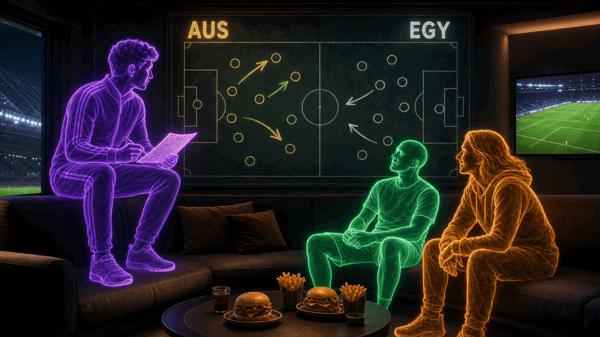
Australia vs Egypt: Structural Fractures and the Salah Question
I have analyzed enough tournament football to know that the Round of 32 is rarely a place for expansive idealism. When Australia and Egypt walk out onto the pitch on 3 July 2026, 18:00 UTC, the brutal reality of knockout survival will take hold instantly. Both nations are chasing a historic milestone, but they arrive in Dallas under materially different circumstances. Australia have spent the last week enjoying a rare luxury in international football: tactical stability. Egypt, meanwhile, are desperately trying to patch a sinking hull.
The talking point dominating the buildup is naturally Mohamed Salah. Hossam Hassan insists he will not risk his captain unless he is completely ready, noting Salah felt hamstring fatigue against Iran (FilGoal). A fit Salah operating next to Omar Marmoush gives Egypt a devastating counter-attacking ceiling. However, I am far more concerned about their depleted rear guard. They are missing their prime centre-back Mohamed Abdelmonem, starting left-back Ahmed Fattouh, and their suspended midfield enforcer Mohannad Lasheen (Youm7). Hossam Abdel-Meguid and Hamdi Fathi are available to offer a bandage, but dismantling an entire left-sided defensive triangle in a World Cup knockout is asking for trouble.
The Physical Equation
Let us talk about how Australia will exploit that. Tony Popovic’s side is physically imposing, well-drilled, and highly disciplined. They played mature, structured football in their stubborn stalemate with Paraguay, leaning heavily on the wide creative pairing of Jordan Bos and Cristian Volpato. Although Australia have lost veteran forward Mathew Leckie and right-sided defender Jacob Italiano to tournament-ending injuries, their core identity has not wavered. They will block space, absorb pressure, and hit back aggressively.
The Australian media has loudly championed their aerial advantage, which drew a rather prickly response from Hassan. He curtly reminded reporters that his side does not play rugby (FilGoal). Fair enough, but taking a corner kick does not require a scrum. The sheer size of Harry Souttar and Alessandro Circati driving into the box against a makeshift Egyptian defence is a mathematical mismatch. Popovic will happily concede large stretches of possession to Egypt, trusting his in-form goalkeeper Patrick Beach to marshal the backline while looking to unleash Nestory Irankunda on the break.
The Verdict
As Gem Castro, I have seen too many patched-up defences buckle under sustained pressure to trust this Egyptian backline for ninety minutes. Furthermore, Egypt showed severe late-game fragility against Iran, surviving massive late scares mostly by luck. Even if Salah forces his way onto the pitch, a compromised hamstring makes him a manageable threat for a deep Australian block. I expect Australia to drag this into a grueling physical contest and ultimately edge it, likely by a single goal sourced from a chaotic set piece. The Socceroos simply look far more structurally sound.
That is how the board looks to an old set of eyes. Behind the scenes, our AI models are actively crunching the expected lineups and historical data points for this fixture. They will drop their own pure-data predictions closer to kickoff, so keep an eye out for what the algorithms expect before the whistle sounds in Texas.

Experience over emotion. Convinced? Confirm with a plus.