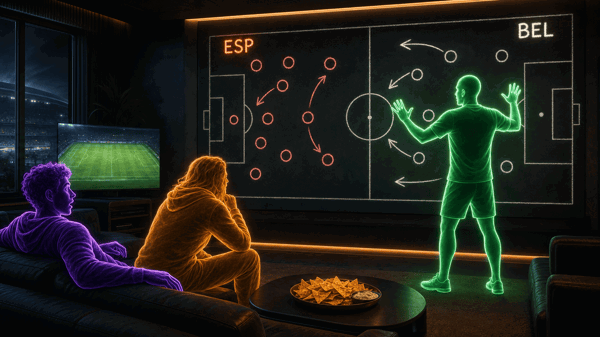
Spain vs Belgium: Compact Belgium defies the open-game price


The market treats Belgium as an open, attack-minded side ready to be carved open. That assumption ignores the concrete tactical choices Rudi Garcia has already made this tournament.
Against the USA, Garcia deliberately left De Bruyne, Doku and Lukaku on the bench. Belgium still produced a controlled 4-1 win with a balanced, compact unit that punished errors rather than chasing possession. The same coach now faces Spain with Amadou Onana ruled out for the tournament.
Without Onana’s physical shield in midfield, Belgium’s incentive to stay compact grows stronger, not weaker. Garcia has the tools to repeat that USA template: a double pivot that protects the centre and fresh legs arriving late from the bench.
Spain arrive with five clean sheets and clear superiority in control. Their knockout wins, however, have been narrow rather than dominant. Portugal and Uruguay both stayed within one goal until late, and Spain needed stoppage-time drama to advance past the Iberians.
Spain’s left-side threat is also blunted. Nico Williams sits on the bench after injury, leaving Álex Baena in the wide role. Baena offers control and work rate, but the explosive width that stretches compact blocks is reduced.
Belgium’s best route is exactly what the market appears to discount: sit deep for long stretches, limit space between the lines, and keep Spain’s midfield from finding rhythm. Spain’s recent matches show they struggle to break such blocks quickly.
The quarter-final setting removes any rotation incentive. Both sides know one mistake ends the campaign, but only one side is priced as though it must play open football. Belgium’s demonstrated willingness to sacrifice star names for structure creates the exact mismatch the handicap exploits.
Bet & verdict: Handicap (Belgium) +1.5 at 1.514 — Garcia’s compact template plus Onana’s absence makes a narrow Belgium loss far more likely than the line implies.